
FLM.RED / After the credits
The Pianist (2002) The hands that can’t touch the keys
Spoilers through the ending, from Szpilman’s radio studio to the abandoned house and the postwar concert.

Open the recap & discussion — spoilers
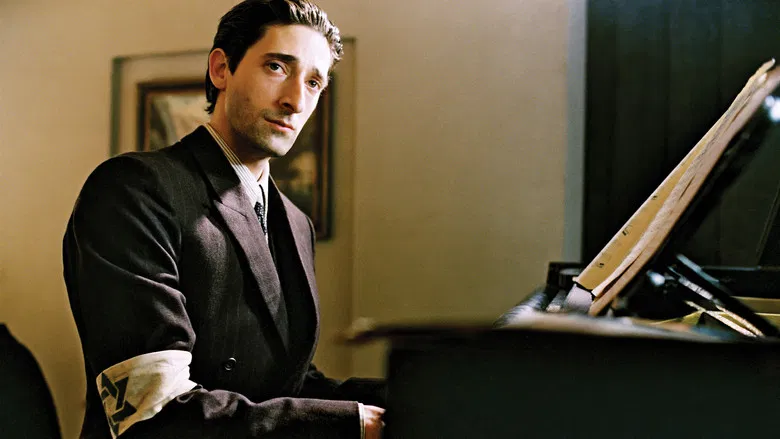
Władysław Szpilman is still playing Chopin at Warsaw’s radio station when the bombs interrupt him. Much later there is a piano in front of him and he can’t press a key. One sound could give away his hiding place. Roman Polanski’s film lets us feel what has happened to a Polish Jewish pianist in the distance between his fingers and the keyboard.
Music we can hear, in a room that has to stay quiet
The opening broadcast uses Chopin’s Nocturne in C-sharp minor to let us hear Szpilman at work before that part of his everyday life is interrupted. Later, in a flat where he’s hiding, he moves his fingers above the keyboard. The soundtrack gives us the music he’s imagining while the room itself stays quiet.
Silence has immediate consequences for him. He has been separated from his family as they are about to be deported, and people who help him find places to hide are part of how he survives. The silent playing lets us see what he can still do for himself after he has lost the freedom to let other people hear his work.
An audience of one in an abandoned house
A German officer, Wilm Hosenfeld, finds Szpilman hiding in the ruined city. When he learns that Szpilman is a pianist, he asks him to play. In the film it’s Chopin’s Ballade No. 1 in G minor. In the memoir, Szpilman describes playing a nocturne. After their encounter Hosenfeld helps him with shelter and brings him food.
Earlier Szpilman was keeping quiet so nobody would discover him. Here he has to play for a man with the power to decide what happens to him. The silence before the music is full of uncertainty, and what Hosenfeld does afterward matters to whether Szpilman survives.
The music he imagined is heard across the hall
After the war, Szpilman returns to the radio. The film closes with Chopin’s Grande Polonaise brillante and an orchestra. The music we heard while his fingers hovered above the keys is now audible to everyone in the hall. The film lets him keep playing as the credits roll.
Hosenfeld’s story ends elsewhere. The closing text records that he died in Soviet captivity in 1952. Szpilman has his work again. The people lost along the way are still part of what we hear as the performance continues.
After the final notes
- When Szpilman’s hands moved above the keys, what did hearing the music change about how close you felt to him?
- Which earlier moment did the concert bring back to you most vividly?