FLM.RED / After the credits
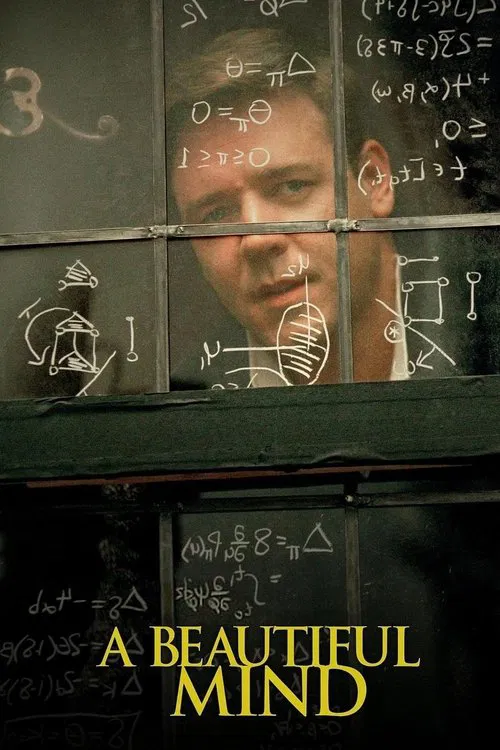
A Beautiful Mind (2001) The seat Nash takes at Princeton
Spoilers through the ending, from Nash asking to come back to Princeton to his colleagues placing their pens on the table.

Open the recap & discussion — spoilers
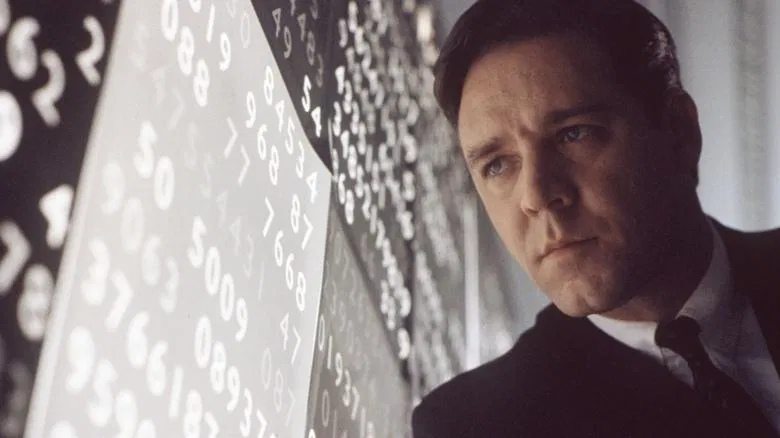
When John Nash asks to use the facilities at Princeton again, he has to ask Martin Hansen, an old rival. Ron Howard gives that ordinary request a place years before the awards ceremony. The distance between a seat in the library and the table where colleagues put down their pens is filled with days Nash spends returning to work in the company of other people.
The girl who never gets older
The film introduces Charles as Nash’s roommate, Marcee as Charles’s niece, and Parcher as the man who gives him secret work. We see them as Nash sees them. When he realizes Marcee has never aged, that small observation changes what we thought we were seeing in a much longer stretch of the film.
The realization leaves him with feelings about Charles and Marcee that mattered to him. The figures are still there at the end. Howard gives us time to see what Nash’s days become when their presence is still part of what he experiences.
Martin gives him a place to work
Back at Princeton, Nash gets access to the university’s facilities. A student eventually approaches him to discuss a theory, and he works his way back into teaching. By the time his colleagues come over one at a time to set down their pens, we’ve had a chance to see him return to the room they share.
The pen ceremony was invented for the film. It draws its force from the smaller scenes that came before it: being allowed back, working among other people, and having a student want to know what he thinks.
After the speech in Stockholm
In the film, Nash thanks Alicia in his award speech. As he leaves, he still sees Charles, Marcee, and Parcher. The film lets professional recognition and Nash’s continuing experience of those figures occupy the same moment. What has changed is who he walks out with and where he chooses to put his attention.
The real Nash shared the 1994 prize in economic sciences with John Harsanyi and Reinhard Selten for work on equilibria in non-cooperative games. The speech thanking Alicia was written for the film. Howard ends by giving Nash a chance to look for the person he wants to acknowledge when he is asked to speak about his life.
After the film
- Which early detail about Charles or Marcee changed meaning for you after the revelation?
- When did Nash seem to belong at Princeton again: when Martin gave him access, when the students came to talk, or when his colleagues laid down their pens?