1997 / 1998
Good Will Hunting
The 1997 film brings a shared original-screenplay Oscar in 1998 and a lead-acting nomination.
 FLM.RED
แมตต์ เดมอน
Knowing the answer, learning what to do with it
From co-writing Good Will Hunting to Jason Bourne and Mark Watney: different kinds of skill under pressure.
Cambridge, Massachusetts, United States
Matt Damon was born in Cambridge, Massachusetts, on 8 October 1970. Good Will Hunting (1997) is a central work in his career as both actor and writer: he plays Will and co-wrote the screenplay with Ben Affleck, with Gus Van Sant directing. At the 1998 Academy Awards, Damon and Affleck won for original screenplay, while Damon also received a leading-actor nomination. The distinction matters to the history of the film, which put his writing and performance before audiences together. For FLM.RED, Will is interesting because intellectual ability does not settle the choices in his life. Damon can make a quick answer feel exhilarating, then let a conversation show the limits of using intelligence to keep another person at a distance. The exchanges with the surrounding cast give that tension somewhere to develop.
The Bourne Identity (2002), directed by Doug Liman, gives Damon another relationship with knowledge. Jason Bourne has formidable practical skills while lacking the memory that would explain them. Franka Potente, Chris Cooper and Brian Cox are among the other performers in the film. In FLM.RED’s reading, the role works through the gap between what a body knows and what a person can account for. Watching Bourne notice a room, react to a threat or measure another person’s intentions becomes part of following the mystery. Damon’s physical performance helps make a problem of identity visible in immediate actions. The character’s competence is therefore also a source of uncertainty: each demonstration of skill raises another question about the life that produced it.
Ridley Scott’s The Martian (2015) places Damon as Mark Watney, an astronaut stranded on Mars who must work to survive and contact Earth. The film brought a leading-actor Oscar nomination in 2016. Its problem-solving offers a third way to approach his work: knowledge becomes something to apply, test and communicate while time and resources remain limited. FLM.RED finds the performance most engaging when humour shares space with effort. A joke can help Watney keep addressing an imagined listener, but it does not make the practical work disappear. Across these three films, Damon’s characters use ability to very different ends, within stories shaped by their collaborators. The linked titles below are films currently associated with him in FLM.RED, rather than his complete acting, writing and production record.
The 1997 film brings a shared original-screenplay Oscar in 1998 and a lead-acting nomination.
Jason Bourne in Doug Liman’s film.
Mark Watney in the 2015 film, with a 2016 lead-actor Oscar nomination.
Performance readings are FLM.RED editorial interpretation.
Titles in this collection; not a complete filmography.
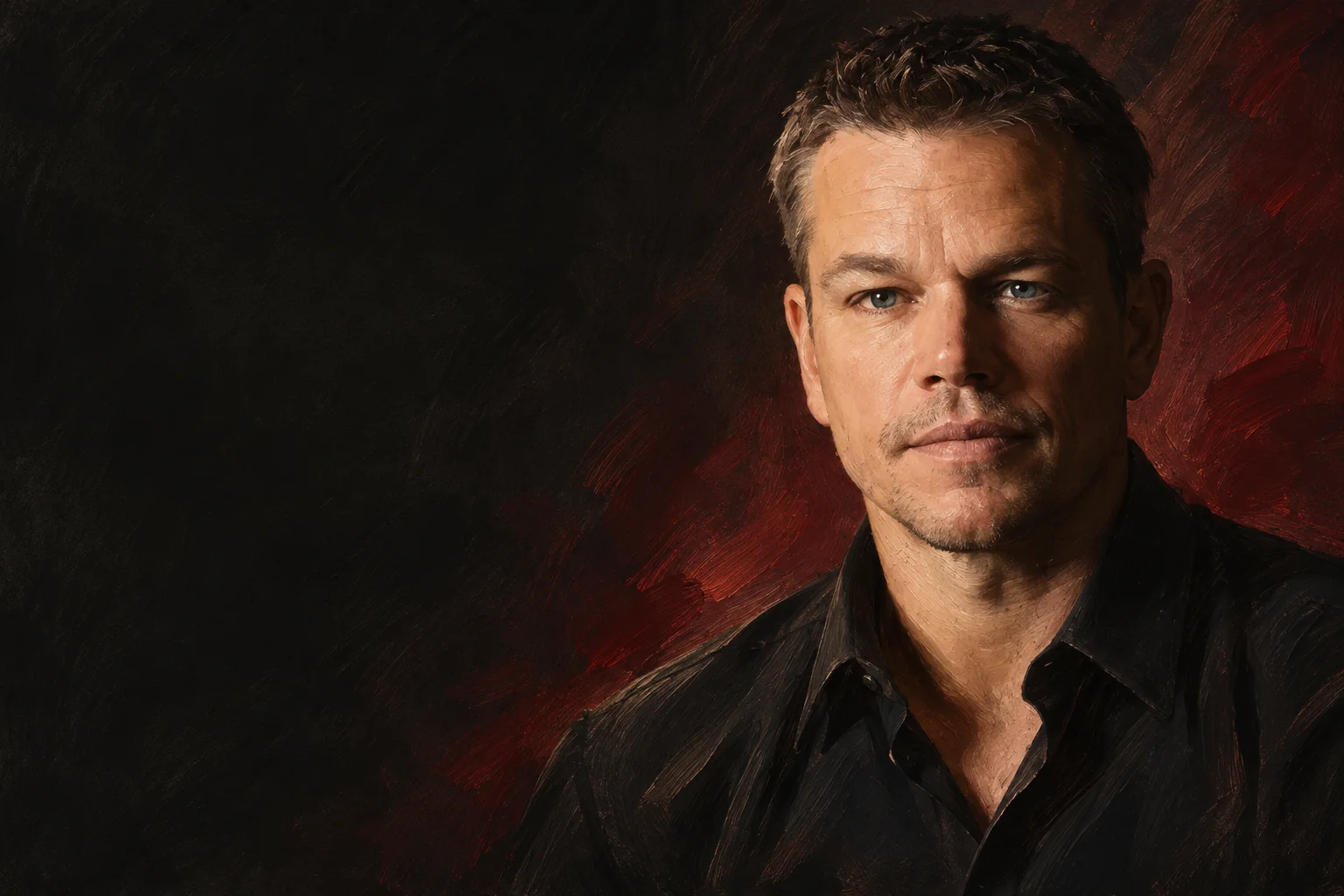
Portrait illustration: FLM.RED.