FLM.RED / After the credits
Madden Why it had to be eleven on eleven
Spoiler warning. This article discusses the closing stretch of Madden (2026) and the outcome of the game project.

Open the recap & discussion — spoilers
David O. Russell gives John Madden a Super Bowl trophy to hold up, but some of the suspense at the end takes place on a computer screen. The figures on it are rougher than anything you would see on a football broadcast. Nicolas Cage’s Madden wants to know whether they move the way football players have to move.
A place to put all that football
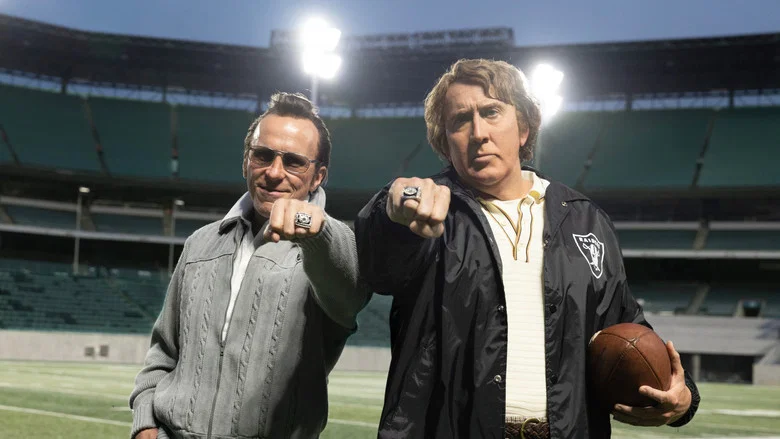
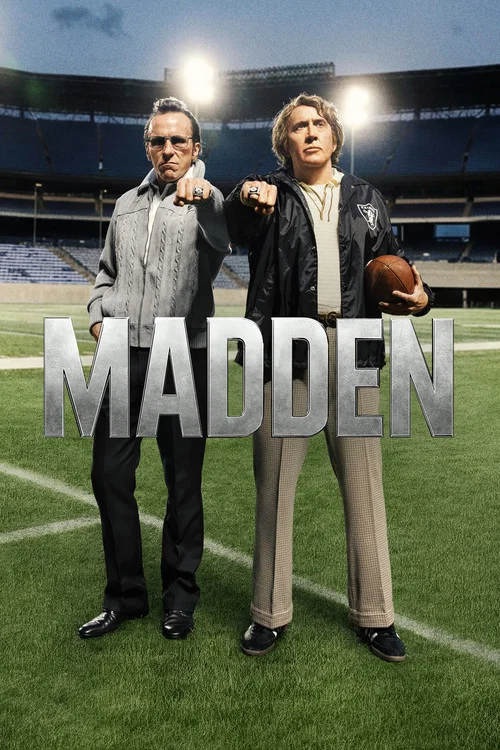
Winning with the Oakland Raiders binds Madden to owner Al Davis, played by Christian Bale. Both men want to win and know how to keep the other working at it. When health problems bring his coaching career to an end, Madden brings that energy home. Kathryn Hahn’s Virginia has to live with how little of his working life he knows how to leave behind.
Broadcasting gives him a different place to use what he knows. With Pat Summerall in the booth, Madden can draw on the picture and show the viewer the reason behind a movement that looked like confusion a moment earlier. By the time he is arguing with people who make computer games, we already know why a small detail can stop him cold.
Eleven on eleven
John Mulaney’s Trip Hawkins approaches Madden about a football computer game. The team tries a seven-a-side version because the hardware can only do so much. Madden insists on eleven a side. The argument has real weight on both ends. One group needs a game that runs. The coach knows that taking players away changes the decisions everybody else on the field has to make.
Late in the film, Madden tests a build on his bus. He sees the figures respond to pressure in a way he recognizes and signs off. The first John Madden Football came out in 1988 with eleven players on each side, as the Pro Football Hall of Fame records. The bus scene gives that result a moment you can watch someone arrive at.
Calling the play yourself
The broadcast booth and the game give the viewer slightly different jobs. On TV, Madden can draw a line and show why a player ran that way. In the game, the person at home can call a play and watch the consequences. The urge to teach that the film gives him as a coach still has somewhere to go once he has left the sideline.
The film ends with the Hall of Fame induction of Al Davis, which brings us back to a relationship that began on the sidelines. On the bus, Madden has something more immediate to be pleased about. A tiny figure on a screen has understood its assignment when a play changed. For this Madden, seeing that work is a reward in itself.
After the game
- What does building the game tell you about Madden that the sideline and the broadcast booth leave out?
- How much would you miss the bus test if the film cut straight from the development arguments to the game’s release?